Connected diagnostics. Governed intelligence.

The intelligence layer for connected diagnostics.

Blazma connects diagnostic orders, laboratories, devices, clinical systems, patients and physicians, turning fragmented diagnostic data into coordinated workflows, intelligent insights and measurable follow-up.

Physicians
Healthcare systems
Laboratories
Patients
Devices
Payers & partners
Vendor-neutralConnect existing healthcare systems
Healthcare-nativeBuilt around diagnostic workflows
Governed AIDesigned for human clinical oversight
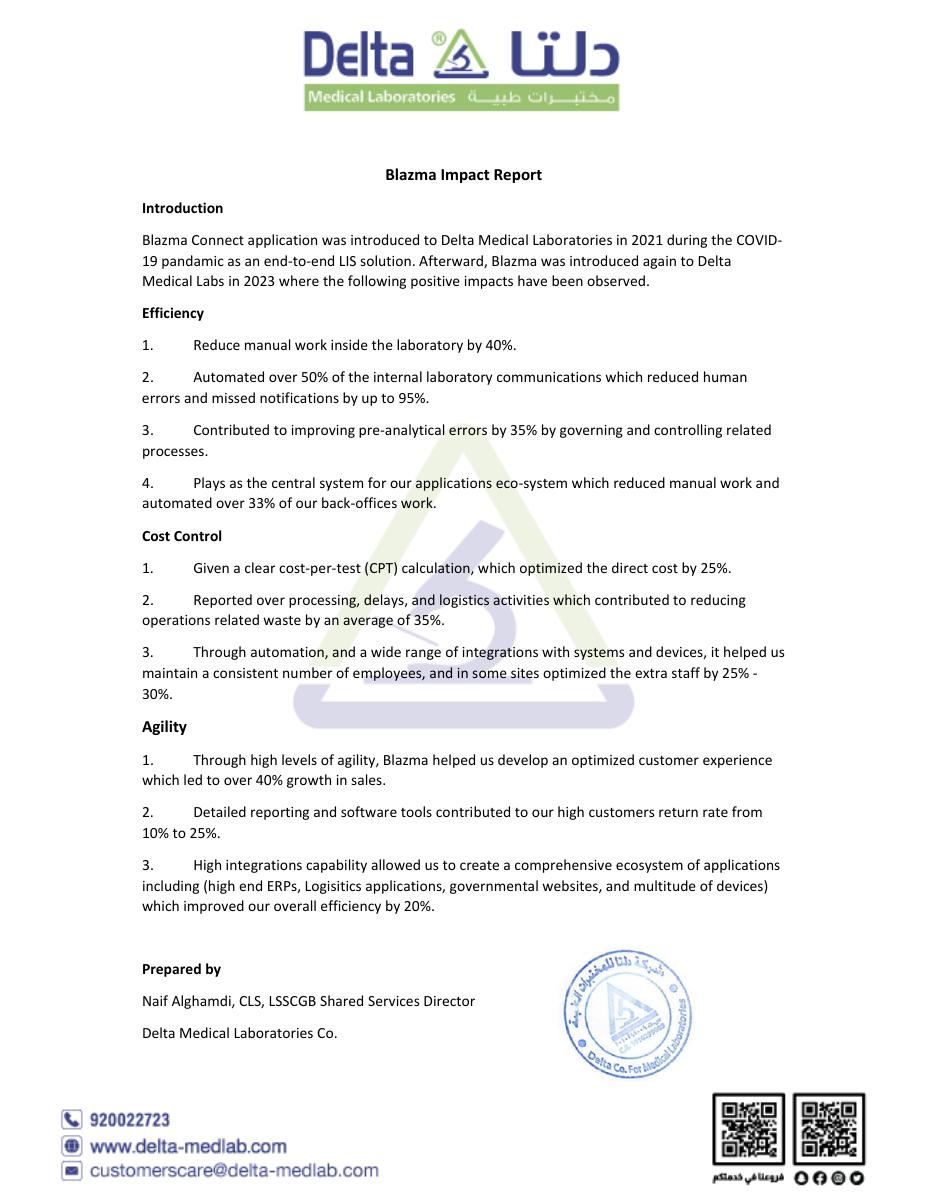
Customer-validated impact

Proven in real diagnostic operations

Delta Medical Laboratories reported measurable operational, financial and commercial improvements following its use of Blazma.

Read the Delta case study
40%↓Manual laboratory workReported reduction
95%↓Human errors & missed notificationsReported reduction of up to 95%
25%↓Direct costReported optimization through CPT visibility
40%+Sales growthReported following customer-experience improvements
Customer-reported outcomes · Delta Medical LaboratoriesView signed impact report ↗
Why now

Diagnostics should be a connected journey, not a chain of disconnected transactions

Orders are often created in one system, executed in another, reviewed elsewhere, and delivered without a connected follow-up process. The result is manual work, repeated testing, incomplete context, delayed referrals, and limited visibility into capacity and cost.

01

Fragmented systems

Clinical, laboratory, payer, device and operational data remain distributed across disconnected applications.

02

Broken handoffs

Important tasks, approvals and escalations can fall between organizations, sites and teams.

03

Limited visibility

Leaders struggle to see true workload, quality, utilization, referral cost and service performance.

04

Results without closure

A verified result does not always translate into documented follow-up and measurable patient response.

The Blazma value chain

Run → Connect → Automate Optimize → Understand

Blazma is not a single-point tool. It creates one operating model across the work itself, the systems around it and the intelligence produced from it.

01

Run

Orders, patients, specimens, analyzers, quality, referrals, billing and follow-up.

02

Connect

HIS, EHR, LIS, ERP, insurers, devices, logistics, patient channels and national platforms.

03

Automate

Routing, communications, exceptions, handoffs, alerts, approvals and back-office work.

04

Optimize

Turnaround, capacity, staffing, inventory, referrals, cost per test, revenue and waste.

05

Understand

Unified diagnostic data, Smart Reports, AI-assisted insights and population intelligence.

Operational foundation

Start with the work. Build intelligence on top of it

Blazma can operate as a full laboratory information system, coordinate multiple existing systems, or extend selected workflows. The architecture is defined by the approved operating model, not by a requirement to replace every system.

Operate

Diagnostic & laboratory operations

Control the journey from electronic request and patient preparation through collection, processing, validation, critical communication and reporting.

Explore operations →
Orchestrate

Integration & workflow automation

Exchange governed data across systems and devices, monitor interfaces, automate handoffs, and route exceptions to accountable owners.

Explore interoperability →
Manage

Business & financial performance

Connect operational activity to cost, capacity, inventory, referrals, revenue, service levels and customer performance.

Explore performance →
Intelligence built on trusted operations

From operational events to diagnostic and business intelligence

Blazma unifies clinical, laboratory, quality, logistics, financial and operational data into decision-ready views. Approved AI can then support trend analysis, prioritization, Smart Reports and population-level insight under defined governance and human oversight.

Operations command

Volumes, TAT, workload, capacity, exceptions, analyzer availability and service levels.

$

Economic intelligence

Cost per test, inventory consumption, referral cost, revenue and reconciliation.

AI

Diagnostic intelligence

Longitudinal trends, abnormal changes, risk prioritization and physician-reviewable insights.

Community intelligence

Governed population indicators, demand patterns, capacity needs and early signals.

Explore data & intelligence
Blazma in action

From software implementation to measurable business impact

At Delta Medical Laboratories, Blazma was used as an end-to-end LIS and central application-ecosystem layer. Delta reported lower manual work, fewer process errors, stronger cost visibility, higher automation and commercial growth.

50%+Internal laboratory communications automated
35%↓Pre-analytical errors
33%+Back-office work automated
20%↑Overall efficiency from integrations
Delta Medical Laboratories Blazma Impact ReportCustomer impact report
Built for complex healthcare environments

One platform. Different operating models

Blazma adapts to the scale, governance and workflows of different healthcare organizations, from individual facilities to multi-site networks and national programs.

Public sector

Government & national programs

National coordination, referral optimization, population intelligence and centralized governance.

Explore
Providers

Hospital networks

Unify diagnostic operations and information across hospitals, laboratories, clinics and central systems.

Explore
Diagnostics

Private & reference laboratories

High-volume processing, B2B clients, logistics, contracts, reporting and commercial operations.

Explore
Start with one priority. Expand as value is proven.

Connect your current diagnostic journey to the entire ecosystem

Request a focused demo